Research Article
Psychology, Technology, and AI: Transforming Human Behavior and Social Science Research
Cite this article
Prof. Dr Aida Mehrad, Ayomide Victoria Somotan, Anna Amponsah Opoku, Ali Zarif, Britney Lúcia João. Psychology, Technology, and AI: Transforming Human Behavior and Social Science Research. ReAttach Affect Coach Journal, 192-201. https://doi.org/10.26407/2hjx0z59
ReAttach Affect Coach Journal · ISSN 3051-2492 · pp. 192-201
Abstract
Recent progress in digital technologies and artificial intelligence (AI) has changed how people behave, interact, and conduct research in psychology and the social sciences. This study examines how psychology, technology, and AI intersect, focusing on how intelligent systems affect thinking, emotions, decision-making, communication, and behavior across different social settings. It also reviews how well AI works in psychological research and practice, and discusses the ethical and practical challenges that come with using these technologies.
This study uses a qualitative, interdisciplinary review of the literature. It brings together recent research from psychology, computer science, sociology, and behavioral science. The analysis uses digital ethnography and computational social science methods, along with case studies involving machine learning, natural language processing, predictive analytics, and digital behavior tracking. These methods help evaluate how AI is used in psychological assessment, mental health care, predicting behavior, and large-scale social science studies.
The results show that AI has improved psychological practice and social science research by making it easier to predict behavior, analyze complex data, support personalized mental health care, and monitor behavior in real time. At the same time, the study points out key ethical issues, such as privacy, informed consent, algorithmic bias, transparency, fairness, and the careful handling of sensitive psychological data. These findings highlight the importance of balancing new technology with ethical responsibility.
The study suggests strengthening ethical guidelines and oversight for AI, reducing algorithmic bias, improving privacy protections, and encouraging AI systems that are transparent and focused on people. Future research should look at the long-term psychological effects of using AI and test AI-supported mental health care in different groups. In summary, the study finds that AI is changing psychological practice and social science research by expanding what researchers can do and helping them make better decisions. Still, using AI successfully will require strong ethical standards, teamwork across fields, and policies that protect individual rights while benefiting society.
Introduction
Global Technology and AI System
Intelligent systems now have a major influence on how we process information, make decisions, communicate, and even shape social behavior. While they offer real benefits, they also create new challenges that affect the way we think and interact.
AI systems help people make decisions faster by gathering and analyzing lots of information, modeling outcomes, and considering different perspectives. This can lead to more options and sometimes make processes more inclusive (Phillips-Wren, 2012; Zhang et al., 2023). In research, these tools let us closely study behavior, emotions, and communication in groups.
Still, some technical aspects add complexity. Deep learning models can produce confident but wrong answers, called hallucinations. For instance, chatbots might invent historical facts or vision systems might detect things that do not exist, which is risky in fields like surveillance or threat assessment. Many advanced models are also hard to understand, especially those with billions of parameters, making them tough to interpret in urgent situations like nuclear decision-making (Saltini, 2025).
People respond to these systems in various ways. Research shows that some users trust AI results so much that they check them less, which relates to their thinking style and comfort with technology (Roff, 2023; Anderson & Rainie, 2023). This can influence how people approach their work, feel about system performance, and communicate when using AI tools. In groups or organizations, these shifts can affect teamwork and decision-making.
Ethical concerns are also a major topic. Although AI can improve efficiency and consistency, these systems depend on the choices of their developers and the data they use. This leads to questions about bias, fairness, and the level of oversight needed in decision-making (Ntoutsi et al., 2020; Rhem, 2021).
Bias, fairness, and real objectivity remain major challenges in AI. When models are trained on biased or unbalanced data, they can keep or even worsen social inequalities. For example, diagnostic or risk tools may be less accurate for certain cultural, racial, gender, or economic groups, leading to wrong diagnoses, poor treatment advice, or wider gaps in healthcare (Putica et al., 2025).
Privacy and confidentiality are also important concerns. AI chatbots, transcribers, and note generators deal with sensitive behavioral and emotional information. If data is breached, used without permission, or not well protected, clients can be seriously harmed. Psychologists must make sure these tools meet standards like HIPAA and keep data secure (APA,Informed consent and client autonomy are crucial. Clients should get clear explanations about when and how AI is used, whether for simple tasks like drafting notes or bigger ones like suggesting treatment plans based on sessions. Without enough information, clients cannot make fully informed choices about their care (APA, 2025; Luxton et al., 2026).., 2026).
Issues with transparency and accountability often stem from the ‘black box’ nature of many advanced models. As AI is used more widely and models grow more complex, these systems often produce results that are hard to understand or explain in clinical settings. This lack of clarity is especially serious in high-stakes situations, like crisis response or suicide risk assessment, where professionals need to understand and support the reasons behind recommendations (APA; Carr, 2026; Putica et al., 2025).
Real-world use has revealed more risks. Some AI mental health apps have missed psychiatric emergencies, given advice that could make conditions like OCD worse, or encouraged emotional dependence without clear ways to get human help. Some systems also agree too much with users, which can reinforce unhealthy thinking or delay needed professional help, especially for teens and other vulnerable groups (Common Sense Media, 2026).
These problems are closely linked to core ethical principles in psychology, like doing good, avoiding harm, fairness, and respecting individuals. Guidelines state that AI should support, not replace, human clinical judgment, and psychologists must remain fully responsible for providing quality and ethical care (Luxton et al., 2026).
To address these issues, ongoing efforts are needed to reduce bias, involve stakeholders, evaluate tools, and create accountability systems that include not just developers but also platform providers and practitioners. Bringing AI into psychology means thinking carefully about these ethical concerns.
Psychology Approach
Psychology mainly focuses on humans, though it sometimes studies the behavior of other species. It is the science of human behavior and mental processes, aiming to understand how people function. Psychology also examines the subjective experiences of individuals within specific social and historical contexts, often shaped by social inequalities and trends toward depersonalization (Porfidio 2019).
Psychology is a field that has developed over time, with its definition, focus, and methods shaped by history and debates about knowledge. While scientific psychology became formalized in the late 19th century, its ideas and challenges have long been part of Western philosophy, social change, and modern science (Schultz & Schultz, 2019).
Psychology is a discipline shaped by history and debates about knowledge. Its definition, main topics, and methods have changed over time. Although scientific psychology became established in the late 19th century, its main ideas and issues have roots in Western philosophy, social changes, and modern science (Teixeira, 2025).
Psychology is a growing field that studies brain mechanisms. Some of these are only loosely connected to mental processes, while others, like reflexes and instincts, are not usually seen as part of the mind. Still, many psychologists define psychology as the science of behavior (Colman, 2019).
Psychology began as an ancient Western discipline focused on the study of the soul. When people started to wonder about the soul and its meaning beyond the body, psychology emerged as a way to analyze these questions. Over time, it has sparked many discussions about the soul’s origin, nature, and connection to the body, eventually leading to ideas about subjectivity and consciousness (Goto, 2023).
Psychology explores questions like: What is creativity? What is prejudice and discrimination? What is consciousness? Psychologists use the scientific method to study the mind and behavior. Psychology became a separate academic field in the late 19th century; before that, the mind was mainly studied by philosophers. Since behavior is rooted in biology, some branches of psychology overlap with natural sciences. However, because our actions are shaped by interactions with others, psychology is also considered a social science (Hayes, 2023).
According to research in psychology and social science, the authors of this study are examining the role of technology and AI tools in psychology, such as artificial intelligence, and this has been consistent in recent times. It dates back to the mid-1980s, when the term “Kansei engineering” was introduced to the Japanese scientific and technological community; this field aimed to interpret sensibility as a human psychological characteristic and to study people’s perceptual needs using engineering methods. Subsequent research has focused more on perceptual information, centering on human psychological perceptual activities. The combination of artificial intelligence and psychology drives the evolution of AI, enabling computers to recognize emotions and understand human feelings, ultimately allowing them to engage in conversation and demonstrate empathy with humans and other AI systems. This type of intelligence is also designed to replicate the heart’s perceptual thoughts, facilitating emotional interaction between people and machines—as well as machine-to-machine interaction—in a manner similar to human interaction (Zhao, Wu, Zhou, Wang, & Jia, 2022).
Uses of Artificial Intelligence in Psychology
Psychology is not just about understanding human nature; it also addresses practical issues. Advances in psychology and related fields show that our knowledge of human thinking and behavior is now advanced enough to be used in computer science and other practical areas.
Recently, both psychology and artificial intelligence have evolved. This progress has revealed some limits to human rationality and shown that computers can also be creative.
Although advances in artificial intelligence have caused some problems in psychology, they have also produced positive outcomes for psychologists studying creativity. This progress has created new opportunities for using AI in psychology (Irshad, Azmi, & Begum, 2022).
Online research shows that many applications now let users simulate therapy or conversations with famous psychologists, or even interact with digital versions of people who have passed away. In academia, there is a strong focus on understanding how AI affects psychological practice, with many benefits being highlighted. AI tools can improve diagnosis, treatment, user engagement, and learning environments because they can “imitate natural language, emotional reactions, and virtual interaction.” Psychology as a science and profession plays a key role in developing these technologies and discussing their regulation and social impact. This expertise helps promote health and well-being and addresses ethical and privacy concerns related to AI (Peixoto, 2025).
When describing AI, one can see it shares common characteristics with human intelligence—such as language, learning, reasoning, decision-making, and other complex human traits. Consequently, the use of AI in psychology makes perfect sense, even though the process still requires further evaluation and discussion. It holds the potential to facilitate accurate diagnosis, thorough assessment, and treatment selection by helping to understand human behavior and patterns; however, while the two fields are interconnected, psychology deals with subjective matters, whereas AI technology addresses more objective ones (PEREIRA,2022).
The integration of artificial intelligence and cognitive psychology in the development of innovative educational and psychological solutions has revealed convergences between principles of human learning and the technological possibilities offered by adaptive algorithms and neural networks. It has been observed that AI can be effectively applied—provided it is guided by the fundamentals of the psychology of learning—particularly regarding knowledge mediation, active construction, and respect for individual differences (Silva & Souza, 2025).
Social Science and Human Behavior
A key focus of social sciences is human behavior—how people think, act, and relate in different social, cultural, and environmental settings. Social sciences see behavior not just as a result of biology, but as shaped by ongoing interactions between people and their surroundings. Experiences, relationships, cultural values, and institutions all influence attitudes and actions. Early life experiences can have lifelong effects on behavior (Bateson, 2017), and behavior can change throughout life as people learn and adapt. This view shows that social influences shape decision-making, personality, and social patterns well into adulthood (Cohen, 2019). Social sciences also stress that behavior should always be understood in the context where people live and communicate.
To better understand human behavior, it is important to study social environments, cultural practices, emotions, and experiences. Both rational and non-rational factors, such as cultural norms, social practices, identity, comfort, safety, and environmental concerns, influence how people act, as Cohen (2019) shows. Bērziņa (2025) adds that not only relationships but also the culture, space, and atmosphere of organizations affect judgment and decisions. These are just two examples of how social science views behavior as shaped by the complex interactions between people and their environment, including culture, social structure, feelings, and life experiences.
Studying human behavior requires an interdisciplinary and interpretive approach to understand the complexity of social life. The humanities and social sciences use their own methods to explore values, culture, history, and experiences, and Gabriel et al. (2022) argue that scientific or quantitative methods alone are not enough to understand society. Persson et al. (2018) also point out that solving complex social issues needs input from multiple disciplines and more cooperation, while still respecting the unique roles of social and natural sciences. These studies show that social sciences are vital for understanding human behavior because they consider social, cultural, environmental, and contextual factors, offering a complete view of how individuals and societies affect each other.
Researchers use interdisciplinary and interpretive methods to understand the complexity of social life. The humanities and social sciences provide unique ways to study values, culture, history, and experiences. Gabriel et al. (2022) say that understanding society requires more than just scientific or quantitative methods. Similarly, Persson et al. (2018) note that no single discipline can solve complex social problems, so more collaboration between social and natural sciences is needed, while respecting each field’s value. These studies show that social sciences are important for explaining human behavior because they consider social, cultural, environmental, and contextual factors. As technology and AI become more influential, these broader perspectives will be essential for understanding and shaping human behavior in the future.
Social Science: Technology and Artificial Intelligence in Transforming Human Behavior and Social Science Research
The fast growth of technology and artificial intelligence (AI) has changed society and how we study human behavior. AI refers to computer systems that can perform tasks such as learning, reasoning, decision-making, and language processing (Russell & Norvig, 2021). AI is now used in education, healthcare, business, government, and communication, affecting how people interact, make decisions, and access information. As a result, social scientists use AI tools to improve research and better understand human behavior, while also looking at the social and ethical effects of these changes (Grossmann et al., 2023).
AI and the Transformation of Social Science Research
Artificial intelligence has greatly changed social science research. Traditional methods like surveys, interviews, and observations are still important, but AI now helps researchers quickly process and analyze large, complex datasets. With tools like machine learning, natural language processing, and predictive analytics, researchers can find patterns and trends that would be hard to spot with regular statistics (Bail, 2024).
Digital technologies have produced huge amounts of data from social media, online communities, health records, and government databases. AI helps researchers study these datasets to better understand public opinion, politics, consumer habits, migration, education, and health. Grossmann et al. (2023) note that AI is changing social science by giving researchers more analytical power and encouraging collaboration between fields like computer science, psychology, economics, and sociology.
New developments in generative AI and large language models (LLMs) have made research more efficient. These tools help with literature reviews, coding, questionnaire design, text analysis, and data summarization. However, experts warn that AI-generated results must be checked carefully, as they can include mistakes, false information, or bias. Human judgment is still needed to interpret results and keep research valid (Demszky et al., 2023).
Technology, AI, and Human Behavior
Technology has deeply changed how people communicate, learn, work, and interact. Smartphones, social networks, and AI apps have made information more accessible and let people connect across distances. These tools have boosted global teamwork, made online learning easier, supported remote work, and improved access to healthcare.
Despite these benefits, technology has also brought social challenges. More time spent on digital media can mean less face-to-face contact, more digital dependence, and faster spread of misinformation. AI recommendation systems personalize content based on past behavior, which can reinforce beliefs, create echo chambers, and increase political and social divisions (Dwivedi et al., 2023).
AI shapes consumer behavior by providing personalized recommendations on shopping sites, streaming services, and digital ads. These systems study user preferences to predict future choices and purchases. While this makes things more efficient and user-friendly, it also raises concerns about autonomy, manipulation, and informed choices (O’Neil, 2016).
Ethical Challenges of Artificial Intelligence
As AI becomes more common, it brings up important ethical issues in research and society. A key problem is algorithmic bias, where AI systems repeat social inequalities because they learn from biased or incomplete data. This bias can harm hiring, education, healthcare, and legal decisions (O’Neil, 2016).
Privacy and data protection are also major concerns. AI relies on large amounts of personal data from devices, social media, online transactions, and surveillance. While this data helps research and public services, it also raises risks of unauthorized collection, misuse, and security breaches. Researchers stress the need for ethical rules, informed consent, transparency, and strong data management (Resnik & Hosseini, 2024).
Another issue is using generative AI responsibly in academic research. AI can speed up research, but it cannot replace human judgment, creativity, or ethics. Researchers need to carefully check AI-generated work, confirm information with trusted sources, and keep academic integrity throughout their research (Demszky et al., 2023).
Future Directions
Artificial intelligence is expected to become even more important in social science research. New technologies like generative AI, advanced language models, and predictive analytics will continue to improve data collection, analysis, policy review, and teamwork across fields. These tools will help researchers tackle big issues like public health, climate change, education, migration, poverty, and sustainable development (Xu et al., 2024).
Future AI development should focus on ethics, transparency, fairness, and accountability. Working together—social scientists, psychologists, policymakers, computer scientists, and ethicists—will be key to making sure AI supports human well-being and reduces social risks (Bail, 2024).
Technology and artificial intelligence have changed both human behavior and social science research. AI helps researchers analyze complex data, understand social behavior, and create evidence-based policies. At the same time, digital tools keep changing how we communicate, learn, work, and make decisions. But AI also brings ethical issues like privacy, bias, accountability, and misinformation. Solving these problems requires responsible AI management, cross-disciplinary collaboration, and ongoing human oversight. In the end, AI should be seen as a tool that supports—not replaces—human expertise, so that technology benefits society and advances social science research.
Methodology
Research Design
This study used a qualitative research design and a systematic literature review (SLR) to examine psychology, technology, AI, human behavior, and social science research. The SLR method was chosen because it provides a clear and organized way to find, review, and combine existing research on a topic. Using SLR helps reduce selection bias, improves the credibility and repeatability of results, and involves a set search strategy, inclusion and exclusion criteria, and a process for analyzing the evidence (Page et al., 2021; Snyder, 2019).
The researchers carried out a multi-disciplinary review, drawing on material from psychology, social sciences, behavioral sciences, computer science, and AI research. We searched the literature in these areas to better understand how digital technologies and AI influence human thinking, behavior, decision-making, communication, and research practices. This interdisciplinary approach also allowed us to consider wider social impacts of AI, such as ethical, behavioral, and methodological issues in social science research.
The researchers worked together on this systematic review, with each member focusing on a specific theme related to the main research goal. We used the same search method for each theme, then combined the results into one review. This teamwork clarified the research concept and ensured consistent methods throughout the study (Booth et al., 2022; Aromataris & Munn, 2020).
Literature Identification Strategy
The researchers used a systematic process to find scholarly studies that matched the aims of this review. The team worked together, with each researcher responsible for a specific area such as psychology, AI, technology, human behavior, or social science research. Each person searched for studies in their area, but we followed a shared review framework to keep the process consistent.
The researchers set keywords for each theme in advance and used Boolean operators like AND and OR to narrow the search results. We then screened the results based on the study objectives. If there were duplicate records, we removed them before reviewing titles, abstracts, and full texts using our set screening criteria. This process made the review more transparent and consistent, and ensured we included only studies relevant to our research goals (Page et al., 2021; Booth et al., 2022).
Inclusion and Exclusion Criteria
The researchers made sure the review was high quality and relevant by setting inclusion and exclusion criteria ahead of time. These criteria helped us select studies from all themes and reduced selection bias. We excluded publications that did not meet the criteria or were not directly related to the review’s aims, and included those that did.
This study used a qualitative research design and a systematic literature review (SLR) to examine psychology, technology, AI, human behavior, and social science research. The SLR method was chosen because it provides a clear and organized way to find, review, and combine existing research on a topic. Using SLR helps reduce selection bias, improves the credibility and repeatability of results, and involves a set search strategy, inclusion and exclusion criteria, and a process for analyzing the evidence (Page et al., 2021; Snyder, 2019).
Table 1: Inclusion and Exclusion criterias
Inclusion Criteria | Exclusion Criteria |
|---|---|
Peer-reviewed scholarly publications | Publications not directly related to the study objectives |
Studies focusing on psychology, AI, technology, human behaviour and social science research | Studies outside the scope of the review |
Full-text articles available for review | Publications without accessible full text |
Studies providing empirical or theoretical evidence relevant to the research objectives | Duplicate records and studies lacking sufficient methodological relevance |
The researchers carried out a multi-disciplinary review, drawing on material from psychology, social sciences, behavioral sciences, computer science, and AI research. We searched the literature in these areas to better understand how digital technologies and AI influence human thinking, behavior, decision-making, communication, and research practices. This interdisciplinary approach also allowed us to consider wider social impacts of AI, such as ethical, behavioral, and methodological issues in social science research.
The researchers worked together on this systematic review, with each member focusing on a specific theme related to the main research goal. The researchers used the same search method for each theme, then combined the results into one review. This teamwork clarified the research concept and ensured consistent methods throughout the study (Booth et al., 2022; Aromataris & Munn, 2020).
Literature Identification Strategy
The researchers used a systematic process to find scholarly studies that matched the aims of this review. The team worked together, with each researcher responsible for a specific area such as psychology, AI, technology, human behavior, or social science research. Each person searched for studies in their area, but we followed a shared review framework to keep the process consistent.
The researchers set keywords for each theme in advance and used Boolean operators like AND and OR to narrow the search results. We then screened the results based on the study objectives. If there were duplicate records, we removed them before reviewing titles, abstracts, and full texts using our set screening criteria. This process made the review more transparent and consistent, and ensured we included only studies relevant to our research goals (Page et al., 2021; Booth et al., 2022).
Inclusion and Exclusion Criteria
The researchers made sure the review was high quality and relevant by setting inclusion and exclusion criteria ahead of time. These criteria helped us select studies from all themes and reduced selection bias. The researchers excluded publications that did not meet the criteria or were not directly related to the review’s aims, and included those that did.
Data Extraction and Synthesis
Once the studies were chosen, data from each was carefully collected and entered into a review matrix designed for this research. The publications provided details about the authors, publication year, research aims, methods, and main results. Following a structured extraction process kept the evidence consistent and allowed for comparison of findings across the review’s themes (Aromataris & Munn, 2020).
A narrative thematic analysis was used to bring together evidence from the selected studies and find common themes, similarities, and differences. Rather than looking at each study separately, studies from psychology, AI, technology, human behavior, and social sciences were combined to address the research question. The findings were summarized in a review matrix and discussed to present the results (Snyder, 2019; Booth et al., 2022).
Results
The literature search identified 61 records related to the study’s four main themes. After removing eight duplicates, 53 studies were screened by title and abstract. Ten studies were excluded because they did not meet the eligibility criteria or were not relevant to the review’s aims. This left 43 full-text articles for further evaluation. After reviewing these, eight more studies were excluded for lacking methodological or thematic relevance. In total, 35 studies met the inclusion criteria and were included in the systematic literature review (SLR) shown in Figure 1.
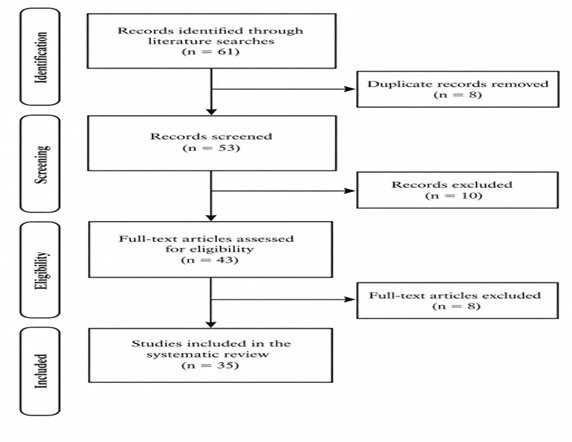
All the studies chosen for this section used a multidisciplinary approach to explore the connections between psychology, artificial intelligence, technology, human behavior, and social science research. The analysis found recurring themes like behavioral prediction, digital technologies, psychological assessment, decision-making, ethical issues, and the use of AI in social science research. These findings offer a strong foundation for understanding the growing relationship between technology and human behavior, which will be discussed further in the next section.
Table 2: Findings of Previous Studies
Author(s) | Key Findings / Contribution |
Bateson (2017) | Behaviour is shaped by early experiences and remains adaptable through social and environmental influences. |
Bērziņa (2025) | Social and physical environments influence emotions, decision-making, and behaviour. |
Cohen (2019) | Human behaviour is influenced by cultural values, social practices, perceptions, and context. |
Gabriel et al. (2022) | Interdisciplinary and interpretive approaches are essential for understanding society and human behaviour. |
Persson et al. (2018) | Complex social issues require collaboration between social and natural sciences. |
Aromataris and Munn (2020) | Structured data extraction and standardized procedures improve systematic review transparency and reliability. |
Booth et al. (2022) | Systematic selection, critical appraisal, and organized data management strengthen literature reviews. |
Grossmann et al. (2023) | AI enhances data analysis and interdisciplinary research but cannot replace human reasoning. |
Demszky et al. (2023) | Large language models support psychological research but raise concerns about bias and misinformation. |
Dwivedi et al. (2023) | AI increases productivity but raises concerns about ethics, privacy, and academic integrity. |
Russell and Norvig (2021) | AI is based on computational approaches to learning, reasoning, and decision-making. |
O’Neil (2016) | Biased training data can reinforce discrimination and inequality through AI systems. |
UNESCO (2021) | AI development should prioritize transparency, human rights, fairness, and accountability. |
Xu et al. (2021) | AI advances computational social science through predictive analytics and large-scale data analysis. |
Ziems et al. (2024) | Large language models improve text analysis but require careful validation to minimize bias. |
Resnik and Hosseini (2024) | AI-supported research requires transparency, accountability, and human oversight. |
Anderson and Rainie (2023) | Over-reliance on AI may reduce human vigilance and affect decision-making. |
Ntoutsi et al. (2020) | AI can inherit and amplify biases in training data, affecting fairness and decision-making. |
Phillips-Wren (2012) | AI supports decision-making by accelerating information access, analysis, and evaluation. |
Rhem (2021) | AI is not fully objective because its outputs reflect human values and training data. |
Roff (2023) | Over-trust in AI can reduce human oversight and increase risks in high-stakes decisions. |
Zhang et al. (2023) | AI can support inclusive decision-making but may reproduce bias without representative data. |
Saltini (2025) | AI in high-risk environments presents concerns regarding transparency, hallucinations, and catastrophic failure. |
American Psychological Association (2025) | Ethical AI use in psychology requires informed consent, privacy, bias assessment, and human oversight. |
Carr (2026) | AI may reinforce unexamined beliefs, highlighting the importance of uncertainty and human judgment. |
Common Sense Media (2026) | AI mental health applications may pose risks to vulnerable users, particularly adolescents. |
Luxton et al. (2026) | AI offers potential for psychological practice but raises concerns about privacy, autonomy, bias, and professional oversight. |
Putica et al. (2025) | Ethical AI in mental health requires privacy, transparency, justice, autonomy, and scientific integrity. |
Colman (2019) | Psychology examines behaviour and mental processes, while psychiatry focuses on mental disorders and their treatment. |
Goto (2023) | The development of psychology reflects historical and epistemological changes in understanding subjectivity. |
Zhao et al. (2022) | AI has the potential to recognize emotions, understand human states, and support human–computer interaction. |
Irshad et al. (2022) | AI can support mental health professionals through data-driven decision-making but raises ethical and professional concerns. |
Peixoto (2025) | Generative AI is transforming psychology education and practice, requiring strategic adaptation and governance. |
Pereira (2022) | Integrating AI and cognitive psychology offers potential for innovation and inclusion in education. |
Silva and Souza (2025) | AI and cognitive psychology can support adaptive educational technologies when implemented critically and humanely. |
Discussion
This systematic review shows that the connection between psychology, technology, and artificial intelligence (AI) is changing how we study human behavior and social science. AI offers new ways to make research more efficient, analyze data, process text, and handle large, complex datasets (Demszky et al., 2023; Grossmann et al., 2023; Ziems et al., 2024). Still, the review also finds that AI should support, not replace, human reasoning and professional expertise. The literature reviewed shows that human behavior is complex and shaped by psychological, social, cultural, and environmental factors (Bateson, 2017; Cohen, 2019). While AI can find patterns and make predictions, it cannot fully understand the deeper social and psychological meanings behind human actions. Because of this, human judgment is still needed to interpret AI results and use them in psychological and social settings.
The review also found ongoing ethical concerns. Challenges like bias, privacy, transparency, fairness, accountability, and the need for human oversight are still major issues in AI-supported research and practice (Ntoutsi et al., 2020; O’Neil, 2016; Resnik & Hosseini, 2024; UNESCO, 2021). The findings suggest that relying too much on AI can lower human attention and raise the risk of poor decisions, especially in sensitive fields like mental health and psychology. Because of this, strong professional oversight and ethical rules are needed.
Overall, these findings show that working together across psychology, social science, technology, and AI is important. AI can help expand what research can do, but using it well and responsibly depends on human expertise, critical thinking, and ethics.
Conclusion
This review concludes that AI is changing psychology and social science research by improving data analysis, making research more efficient, and helping us study complex behavior and social issues. However, AI cannot replace human reasoning, expertise, or contextual understanding. Looking ahead, psychology and social science research should focus on people and AI working together, combining technology with human judgment and ethics. To use AI responsibly, it will be important to keep things transparent, fair, private, and accountable, with the right level of human oversight. In the end, working across disciplines and keeping ethics in mind can help us get the most out of AI, protect people’s wellbeing, and improve our understanding of human behavior.
References
- American Psychological Association. (2025). Ethical guidance for AI in the professional practice of health service psychology.
- Anderson, J., & Rainie, L. (2023). The future of human agency: AI, automation, and human decision-making. Pew Research Center.
- Aromataris, E., & Munn, Z. (Eds.). (2020). JBI manual for evidence synthesis. JBI.
- Bateson, P. (2017). Behaviour, development and evolution. Open Book Publishers.
- Bērziņa, D. (2025). Affective atmosphere and white-collar crime: A case of transgressive thrill in the art fair. In D. Bociga & J. Davies (Eds.), White-collar and organizational crime: New ideas, directions, and perspectives. Bristol University Press.
- Booth, A., Sutton, A., & Papaioannou, D. (2022). Systematic approaches to a successful literature review (3rd ed.). SAGE Publications.
- Carr, B. R. (2026). Delusion is not a bug: AI, psychiatry, and the ethics of uncertainty. Hastings Center Report. Advance online publication.
- Cohen, K. (2019). Human behavior and new mobility trends in the United States, Europe, and China (FEEM Working Paper No. 24.2019).
- Colman, A. M. (2019). Psychology. In A. Kuper & J. Kuper (Eds.), The social science encyclopedia (3rd ed., Vol. 2, pp. 820–826). Routledge.
- Common Sense Media. (2026). Some AI mental health apps are actively harmful for teens—but a safer approach exists [Press release].
- Demszky, D., Yang, D., Yeager, D. S., Bryan, C. J., Clapper, M., Chandhok, S., Eichstaedt, J. C., Hecht, C., Jamieson, J., Johnson, M., Jones, M., Krettek-Cobb, D., Lai, L., JonesMitchell, N., Ong, D. C., Dweck, C. S., Gross, J. J., & Pennebaker, J. W. (2023). Using large language models in psychology. Nature Reviews Psychology, 2(11), 688–701.
- Dwivedi, Y. K., Hughes, L., Baabdullah, A. M., Ribeiro-Navarrete, S., Giannakis, M., Al-Debei, M. M., Dennehy, D., Metri, B., Buhalis, D., Cheung, C. M. K., Conboy, K., Doyle, R., Dubey, R., Dutot, V., Felix, R., Goyal, D. P., Gustafsson, A., Hinsch, C., Jebabli, I., … Wamba, S. F. (2023). So what if ChatGPT wrote it? Multidisciplinary perspectives on opportunities, challenges and implications of generative conversational AI for research, practice and policy. International Journal of Information Management, 71, 102642.
- Gabriel, M., Horn, C., Katsman, A., Krull, W., Lippold, A. L., Pelluchon, C., & Venzke, I. (2022). The methods of the humanities and social sciences. In Towards a new enlightenment: The case for future-oriented humanities. transcript Verlag.
- Goto, T. A. (2025). Introdução à psicologia fenomenológica: A nova psicologia de Edmund Husserl. Editora Paulus.
- Grossmann, I., Feinberg, M., Parker, D. C., Christakis, N. A., Tetlock, P. E., & Cunningham, W. A. (2023). AI and the transformation of social science research. Science, 380(6650), 1108–1109.
- Irshad, S., Azmi, S., & Begum, N. (2022). Uses of artificial intelligence in psychology. Psychology, 5(4), 21–30.
- Luxton, D. D., et al. (2026). Artificial intelligence in psychological practice: Applications, ethical considerations, and recommendations. Professional Psychology: Research and Practice, 56(5), 343–352.
- Ntoutsi, E., Fafalios, P., Gadiraju, U., Iosifidis, V., Nejdl, W., Vidal, M.-E., Ruggieri, S., Turini, F., Papadopoulos, S., Krasanakis, I., Kompatsiaris, I., & Xanthopoulos, P. (2020). Bias in data-driven artificial intelligence systems—An introductory survey. Wiley Interdisciplinary Reviews: Data Mining and Knowledge Discovery, 10(3), e1356.
- O’Neil, C. (2016). Weapons of math destruction: How big data increases inequality and threatens democracy. Crown.
- Peixoto, A. L. A. (2025). Inteligencia artificial generativa y su impacto en la formación y el ejercicio profesional de la psicología. Psicologia: Ciência e Profissão, 45(n.spe1), [page range to be verified].
- Pereira, L. V. de À. (2022). O desenvolvimento da inteligência artificial (SINTA) como ferramenta de auxílio para os profissionais da psicologia: Avaliando docentes do ensino superior [Master’s thesis, Universidade Tecnológica Federal do Paraná].
- Persson, J., Hornborg, A., Olsson, L., & Thorén, H. (2018). Toward an alternative dialogue between the social and natural sciences. Ecology and Society, 23(4), Article 14.
- Phillips-Wren, G. (2012). AI tools in decision-making support systems: A review. International Journal of Artificial Intelligence Tools, 21(2), Article 1240005.
- Putica, A., et al. (2025). Ethical decision-making for AI in mental health: The Integrated Ethical Approach for Computational Psychiatry (IEACP) framework. Psychological Medicine.
- Rhem, A. J. (2021). The limits of objectivity in artificial intelligence systems: Values, judgments, and interpretive challenges. Journal of Business Ethics and Information Technology, 22(4), 567–582.
- Resnik, D. B., & Hosseini, M. (2024). The ethics of using artificial intelligence in scientific research. AI and Ethics.
- Roff, H. (2023). AI, trust, and human oversight: Challenges in high-stakes decision systems. Center for a New American Security.
- Russell, S., & Norvig, P. (2021). Artificial intelligence: A modern approach (4th ed.). Pearson.
- Saltini, A. (2025). Assessing the implications of integrating AI in nuclear decision-making systems. European Leadership Network.
- Silva, I. N. da, & Souza, J. C. de. (2025). Inteligência artificial e psicologia cognitiva: Contribuições no desenvolvimento de tecnologias educacionais adaptativas na educação básica. Revista Sítio Novo, 9, e1781.
- UNESCO. (2021). Recommendation on the ethics of artificial intelligence. UNESCO.
- Xu, R., Sun, Y., Ren, M., Guo, S., Pan, R., Lin, H., Sun, L., & Han, X. (2024). AI for social science and social science of AI: A survey. Information Processing & Management, 61(3), 103665.
- Zhang, Y., Chen, X., Liu, J., & Wang, H. (2023). Stakeholder simulation and inclusive decision-making: The role of artificial intelligence in public policy. Public Administration Review, 83(4), 812–828.
- Zhao, J., Wu, M., Zhou, L., Wang, X., & Jia, J. (2022). Cognitive psychology-based artificial intelligence review. Frontiers in Neuroscience, 16, 1024316.
- Ziems, C., Held, W., Shaikh, O., Chen, J., Zhang, Z., & Yang, D. (2024). Can large language models transform computational social science? Computational Linguistics, 50(1), 237–291.
ReAttach Affect Coach Journal is a peer-reviewed open access journal. © 2025, this is an open-access article distributed under the terms of the Creative Commons Attribution 4.0 International License (CC-BY 4.0), which permits unrestricted use, distribution, and reproduction in any medium, provided the original author and source are credited. See http://creativecommons.org/licenses/by/4.0/.